
Google krijgt miljardenklap: EU wint strijd om Android-macht

Google heeft definitief bakzeil gehaald in een jarenlange juridische strijd met de Europese Unie. Het Hof van Justitie van de EU heeft het hoger beroep van Google en moederbedrijf Alphabet afgewezen. Daarmee blijft een boete van ongeveer 4,1 miljard euro staan voor machtsmisbruik rond Android, het besturingssysteem dat op miljarden smartphones draait. De zaak draait om afspraken die Google maakte met fabrikanten van Android-telefoons en mobiele netwerkoperators. Volgens de Europese Commissie gebruikte Google zijn sterke positie om ervoor te zorgen dat Google Search en Chrome standaard op Android-toestellen werden geïnstalleerd. Ook stelde het bedrijf voorwaarden aan het gebruik van de Play Store en beperkte het de verkoop van toestellen met niet-goedgekeurde Android-versies.
Van recordboete naar definitieve nederlaag
De Europese Commissie legde Google in 2018 oorspronkelijk een boete op van 4,34 miljard euro. Dat was op dat moment de hoogste mededingingsboete ooit in Europa. In 2022 bevestigde het Gerecht van de EU grotendeels het besluit van de Commissie, maar verlaagde het de boete naar 4,125 miljard euro.
Google ging daarna opnieuw in beroep, dit keer bij het hoogste Europese rechtscollege. Maar ook daar kreeg het bedrijf geen gelijk. Volgens het Hof mocht het Gerecht oordelen dat Google met zijn Android-afspraken de concurrentie beperkte en zijn dominante positie in online zoeken versterkte.
‘Beroep van Google en Alphabet is afgewezen’
“Het beroep van Google en moederbedrijf Alphabet tegen het arrest van het Gerecht wordt afgewezen,” stelt het Hof van Justitie van de EU in zijn persbericht over de uitspraak. Daarmee bevestigt het Hof de boete voor misbruik van een dominante positie via Google Search binnen het Android-ecosysteem. Android is voor Google veel meer dan alleen software voor smartphones. Het systeem vormt een toegangspoort tot zoekopdrachten, advertenties, apps en gebruikersdata. Door Google Search en Chrome standaard op toestellen te laten plaatsen, kreeg Google volgens Brussel een voordeel dat concurrenten moeilijk konden inhalen.
De Europese Commissie stelde al in 2018 dat Google sinds 2011 illegale beperkingen oplegde aan fabrikanten en operators om zijn dominante positie in algemene zoekdiensten te beschermen. Volgens de Commissie ging het daarbij onder meer om verplichte bundeling van Google Search, Chrome en de Play Store, anti-fragmentatie-afspraken en bepaalde afspraken over advertentie-inkomsten.
Google: Android blijft open en gratis
Google is teleurgesteld over de uitspraak. Tegen Reuters zei een woordvoerder dat het oordeel volgens het bedrijf onvoldoende rekening houdt met de investeringen die Google heeft gedaan om Android open, interoperabel en gratis te houden. Google benadrukt ook dat het zijn afspraken al in 2018 heeft aangepast om aan het besluit van de Europese Commissie te voldoen. Toch verandert dat niets aan de uitkomst: de boete blijft staan. De uitspraak is bovendien een belangrijke overwinning voor Brussel, dat al jaren probeert de macht van grote techbedrijven in te perken. Volgens Reuters heeft Google de afgelopen jaren bijna 11 miljard euro aan EU-boetes gekregen in verschillende mededingingszaken.
Signaal aan Big Tech
De zaak past in een bredere Europese aanpak van grote technologiebedrijven. De Financial Times noemt de uitspraak een belangrijke overwinning voor de Europese aanpak van Big Tech, terwijl The Wall Street Journal benadrukt dat dit de zwaarste antitrustsanctie tegen Google in Europa bevestigt. De Android-uitspraak staat los van de eerdere Google Shopping-zaak, waarin Google ook verloor. In die zaak ging het om een boete van 2,42 miljard euro omdat Google zijn eigen prijsvergelijkingsdienst zou hebben bevoordeeld in zoekresultaten. Ook die boete werd uiteindelijk door het Hof van Justitie bevestigd.
Met deze uitspraak komt een juridische strijd van acht jaar tot een einde. Voor Google is het een zware nederlaag, maar voor de EU is het vooral een bevestiging dat haar harde lijn tegen machtsmisbruik door techreuzen standhoudt bij de rechter. Tegelijk is de strijd tussen Brussel en Silicon Valley nog niet voorbij. Onder de Digital Markets Act houdt de EU grote platforms extra scherp in de gaten. Google kan dus ook na deze Android-zaak nog vaker te maken krijgen met Europese onderzoeken, verplichtingen en mogelijk nieuwe boetes.
De uitspraak
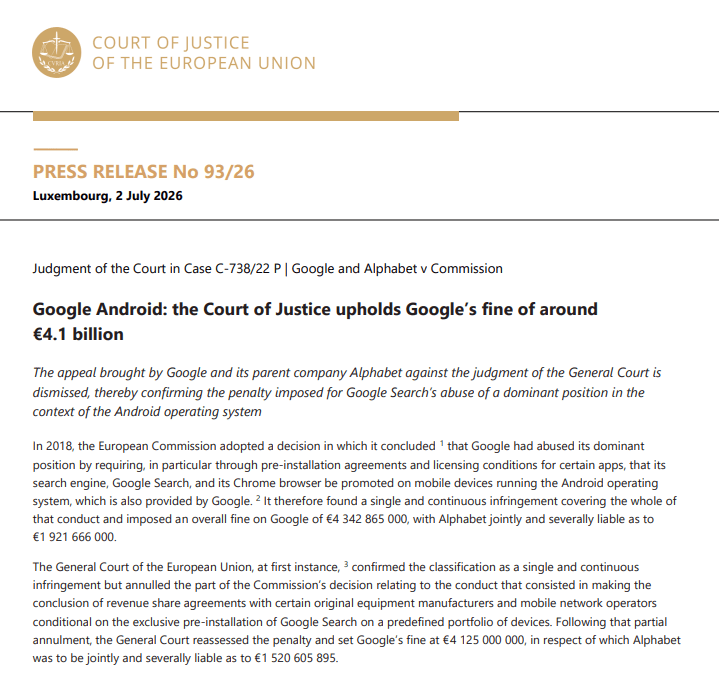
Judgment of the Court in Case C-738/22 P | Google and Alphabet v Commission Google Android: the Court of Justice upholds Google’s fine of around €4.1 billion The appeal brought by Google and its parent company Alphabet against the judgment of the General Court is dismissed, thereby confirming the penalty imposed for Google Search’s abuse of a dominant position in the context of the Android operating system In 2018, the European Commission adopted a decision in which it concluded 1 that Google had abused its dominant position by requiring, in particular through pre-installation agreements and licensing conditions for certain apps, that its search engine, Google Search, and its Chrome browser be promoted on mobile devices running the Android operating system, which is also provided by Google. 2 It therefore found a single and continuous infringement covering the whole of that conduct and imposed an overall fine on Google of €4 342 865 000, with Alphabet jointly and severally liable as to €1 921 666 000. The General Court of the European Union, at first instance, 3 confirmed the classification as a single and continuous infringement but annulled the part of the Commission’s decision relating to the conduct that consisted in making the conclusion of revenue share agreements with certain original equipment manufacturers and mobile network operators conditional on the exclusive pre-installation of Google Search on a predefined portfolio of devices. Following that partial annulment, the General Court reassessed the penalty and set Google’s fine at €4 125 000 000, in respect of which Alphabet was to be jointly and severally liable as to €1 520 605 895.
The Court of Justice dismisses the appeal brought by Google and Alphabet against that judgment of the General Court, thereby confirming the penalty imposed on them, as revised by the General Court, for their anticompetitive practices relating to the Android operating system. First, the General Court did not err in law when assessing the anticompetitive effects of the pre-installation conditions laid down by the Android agreements. The Court of Justice considers that the General Court was entitled to take account of the relevant economic context in its entirety, including the revenue share agreements, without it being necessary systematically to carry out any counterfactual analysis in order to establish an infringement of the prohibition of abuse of a dominant position. It also confirms that the General Court was entitled to find that there was a status quo bias in favour of pre-installed apps and that Google and Alphabet had not demonstrated that user preferences or the alleged quality of their services alone accounted for the behaviours observed. Second, the General Court did not err in law by confirming the Commission’s assessment of the pre-installation conditions laid down by the Android agreements. Demonstrating an abuse of a dominant position is not conditional in any case on proof of a capability to foreclose only as-efficient competitors. Given the particular characteristics of the digital markets concerned, the General Court was entitled to conclude that those practices were liable to restrict competition and strengthen barriers to entry without applying that test. Third, the General Court did not err in law by confirming the Commission’s assessment of the anti-fragmentation Communications Directorate Press and Information Unit curia.europa.eu Stay Connected! agreements. Those agreements were liable to limit commercial markets for non-compatible Android versions and thus to strengthen Google’s dominant position. A counterfactual analysis was not necessary in the circumstances of this case, the anticompetitive effects of the conduct having been sufficiently established. Fourth, the General Court was entitled to reject the objective justifications put forward by Google in relation to the antifragmentation agreements and to maintain the classification of the infringement as single and continuous despite the partial annulment in respect of certain revenue share agreements, since the remaining abuses still formed part of the same anticompetitive strategy. Lastly, the Court of Justice endorses the exercise by the General Court of its unlimited jurisdiction to set the amount of the fine, ruling that its reasons were sufficient and that the procedural principles invoked by Google and Alphabet, including rights of defence, were adhered to.
NOTE: An appeal, on a point or points of law only, may be brought before the Court of Justice against a judgment or order of the General Court. In principle, the appeal does not have suspensive effect. If the appeal is admissible and well founded, the Court of Justice sets aside the judgment of the General Court. Where the state of the proceedings so permits, the Court of Justice may itself give final judgment in the case. Otherwise, it refers the case back to the General Court, which is bound by the decision given by the Court of Justice on the appeal. Unofficial document for media use, not binding on the Court of Justice. The full text and, as the case may be, an abstract of the judgment is published on the CURIA website on the day of delivery. Press contact: Jacques René Zammit ✆ (+352) 4303 3355. Images of the delivery of the judgment are available on ‘Europe by Satellite’ ✆ (+32) 2 2964106. 1 Commission Decision C(2018) 4761 final of 18 July 2018 relating to a proceeding under Article 102 TFEU and Article 54 of the EEA Agreement (Case AT.40099 – Google Android). 2 The contested restrictions fell into three categories: – first, those contained in ‘distribution agreements’, requiring manufacturers of mobile devices to pre-install the general search (Google Search) and (Chrome) browser apps in order to be able to obtain a licence from Google to use its app store (Play Store); – second, those contained in ‘anti-fragmentation agreements’, under which the operating licences necessary for the pre-installation of the Google Search and Play Store apps could be obtained by mobile device manufacturers only if they undertook not to sell devices running versions of the Android operating system not approved by Google; – third, those contained in ‘revenue share agreements’, under which the grant of a share of Google’s advertising revenue to the manufacturers of mobile devices and the mobile network operators concerned was subject to their undertaking not to pre-install a competing general search service on a predefined portfolio of devices. According to the Commission, the objective of all those restrictions was to protect and strengthen Google’s dominant position in relation to general search services and thus the revenue obtained by Google through search advertisements.
The common objective and the interdependence of the restrictions at issue therefore led the Commission to classify them as a single and continuous infringement of the prohibition of abuse of a dominant position. 3 Judgment of the General Court of 14 September 2022, Google and Alphabet v Commission (Google Android), T-604/18 (see also Press Release No 147/22).